Thursday, March 22, 2012

Three Pink Poems for David Trinidad


Anne Sexton

Three Pink Poems
for David Trinidad

__________________

"Pink and smooth as a baby"
—David Trinidad, "Pink Poems,"
Plasticville

Ted Hughes Pink

Frequently in the woods—
In the moody Mytholmroyd moors
A simply despicable Pink
Prick—tiny—prepucial...
Ted’s Pouty Pink Penis

Sylvia Plath Pink

A young workman saunters by—
He catches bored Sylvia’s
Jaundiced New Yorker eye
Such a cute Fitzroy foxy stud
His nice cute tight butt as
Smooth as a pink baby’s ass

Anne Sexton Pink

Sylvia and Anne camp it up—
Over extra dry pink martinis
After Miss Lowell hamming it up
Between all those breakdowns
Celebrating his Pink Uterus


Wednesday, March 21, 2012

Plath’s Prosopopeia


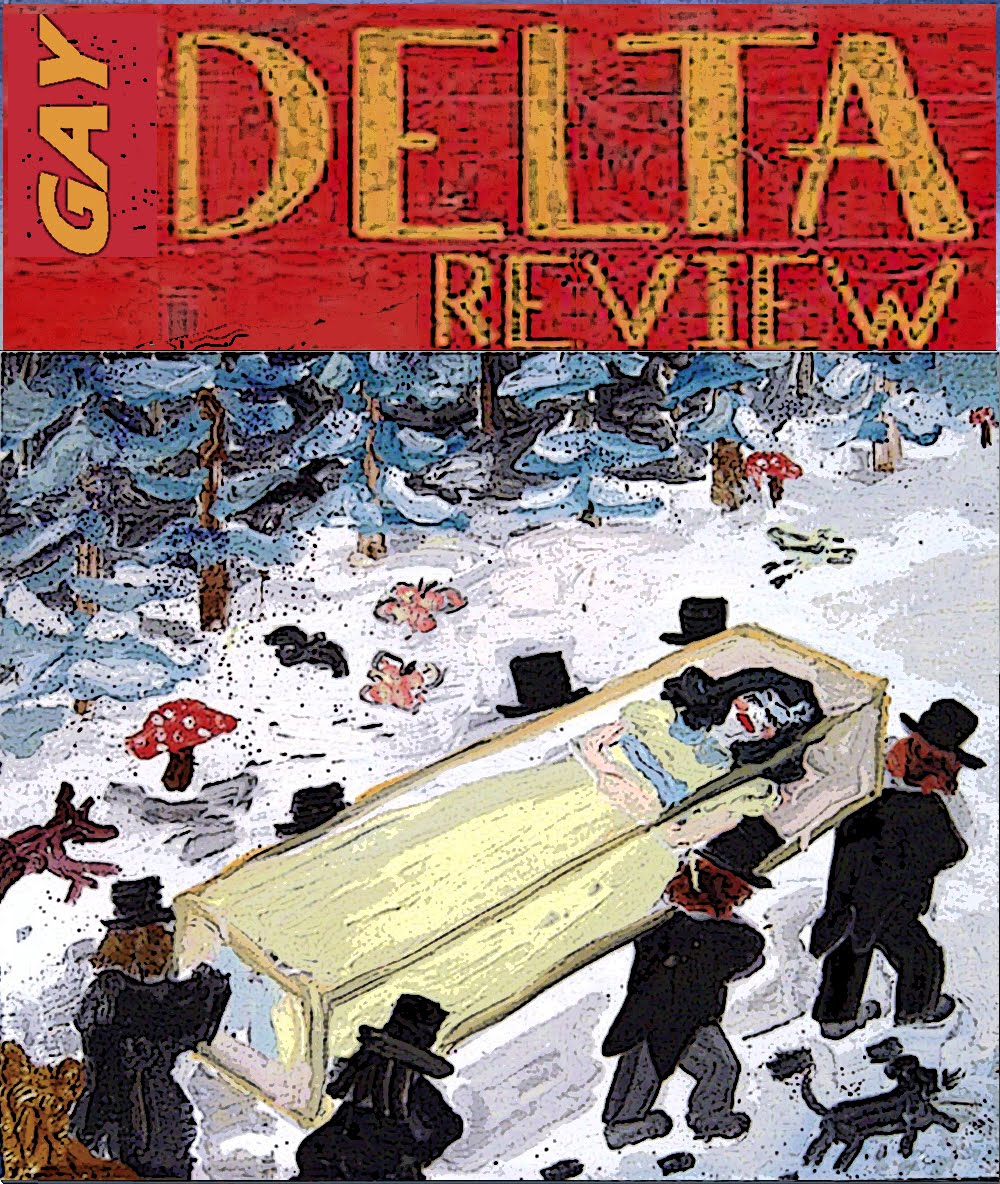
Stella Vine “Snow White in the Forest”

Plath’s Prosopopeia
__________________

“A. Alvarez famously
commented that some of
Plath’s Ariel poems seem to
have been written after her
suicide” —Claire Raymond
The Posthumous Voice in
Women's Writing from Mary
Shelley to Sylvia Plath
_______________

Plath seems to be already—
Dead in her Ariel poems
As if she were already one
The Living Dead

She seems posthumous—
As if she’s deploying her
Voice purposely away
From just Biography

Plath’s disembodied—
Posthumous Voice so
Very much like Brontë
Dickinson and Shelley
_____________

How can a dead poet—
Speak and why does she
Have to be dead in order
To be able to speak?

Sylvia is subversive—
She focuses on the
Bodilessness of the
Dead feminine Voice

She shifts the ground—
Of the project of elegy
And reclaims it for a
Feminine speaker
__________________

Sylvia’s self-elegy—
Steals into the male
Exclusive realm of
Elegy makes it hers

Staging this feint—
Of elegy spoken by
A dead narrator for
Herself is radical

Plath inscribes her—
Posthumous poetry
Historically not for
Female mourning
________________

But rather to turn—
The pastoral topos
Into self-elegy that
Isn’t ruled by males

Invoking as well as—
Problematizing the
Voice of death lets
Her speak for herself

Plath mocks & mourns—
The traditional role of
Tragic poetess by making
Self-elegy her own
______________

A critical vestige of—
Enlightenment feminism
Like the sublime work of
Mary Wollstonecraft

Arguing against the—
Notion that women are
Naturally only concerned
With self-decoration

Using Jacques Rousseau—
To shift the scandalous
And surreal dislocation of
Feminine beyond décor
_________________________

Ditching the hysterical—
Woman displacement of
Grief into ironic death
Spoken thru Ariel poetry

Lady Lazarus doesn’t—
Return to life but haunts
The text speaking from
The Land of the Dead
_________________________

Plath uses her Voice—
Spectral & disembodied
To posthumously speak
Even before she’s dead

Plath speaks as one—
Of the Living Dead before
She dies thus sustaining
The resurrected Poet


Plath’s Prosopopeia II


Stella Vine “Snow White in the Forest”

Plath’s Prosopopeia II
__________________

“in the elegy
longing is always
erotically charged”
—Claire Raymond
The Posthumous Voice in
Women's Writing from Mary
Shelley to Sylvia Plath
______________

Text as theater—
“The Rabbit Cather”
As the longing in
Elegy for the dead

Jacqueline Rose—
Interpreted the poem
As encoding lesbian
Erotic longing

Ted Hughes—
Irate widower and
Literary executor said
“Grounds for Homicide!!!”
_________________

Don’t Ask Don’t Tell—
Applied to the sacrosanct
Masculine tradition of
Elegy excluding women

The male elegy genre—
Guarding itself against
Interpenetration with
The feminine genre

A place of force—
Keeping out Sylvia
From mourning for
Herself or another
______________

The smokescreen—
Of slander thrown up
Attempting to reclaim
Str8t sanctity of marriage

The intensity of a Poem—
To generate the problematic
Of maligned maternity and
Gay perverted parentage

A shocking homicidal Poem—
Highlighting the role of both
Literary Executor and hardly
Divine pastoral Executioner
________________

The Hunter haunts us—
Encouraged by the flap between
Rose and Hughes emphasizing
The male rule over the pastoral

The Hunter is written into—
Plath’s poem seemingly to
Perform the role of impresario
To the rabbit’s dead Voice

The narrator speaking—
Is the aphasiac whose
Voice had been torn out
By the roots & gagged
____________________

It’s a place of force—
That threatens the speaker
And forces her voice out,
Forces her to speak

Voicelessness suffers—
Gagging and tearing
Following the trajectory
Of the Voice in the text

Down thru the—
Rabbit hole & labyrinth
Of “The Rabbit Catcher”
The Voice torn out turns
______________________

The Speaker is speaking—
With a voice that has been
Violently taken away from
Her, shoved into her

How does the Speaker—
Speak since she too is a
Rabbit catcher, catcher
Of her own Voice?

The Speaker is chasing—
Her own Voice, the chase
Is the text of her poem,
Surviving her Voice’s death
__________________

The Rabbit & Speaker’s voice—
Merge in “The Rabbit Catcher”
Opening up Plath’s landscape
Aboveground while down below…

Each of us as Rabbit Catchers—
Chase our own Speaker Hunter
Voices uncannily tied to our own
Underworld suppressed prey

Plath’s poem stages the—
Subterranean recuperation of our
Already dead posthumous Voice
Prefiguring escape thru trope
________________

The poem’s trap thru trope—
Posthumous speech becoming
Plath’s trap door, a trope door,
Escaping & reaching the Reader

Yorkshire Killer


Yorkshire Killer
__________________

“Molding onto his lips like lies,
Complicating his features.
—Sylvia Plath, “Stings,”
The Collected Poems

____________________________________

Bare-assed, rooster combed—
The man with lying smiles
Caught bare-handed
His cheesy paws so neat & sweet

It is almost over—
I no longer have any control
Here is my honey-machine
I’m such an industrious virgin
_____________________________________

Here I am getting old—
Always fucking without thinking
My wings torn & worn out
Is there any queen left at all?

Pussy rubbed of its plush—
Poor and bare and unqueenly
Perhaps even shameful
He simply hates me
__________________________

Once a miraculous lover—
Now he's just an old honey-sucker
I've seen his strangeness evaporate
Now he's just full of lies

Sour creaming Tart—
Scouring the back alleys
The queen bees are watching
The bee-sitters are impatient
_____________________

Here is his slipper—
There are his dirty shorts
Not a square of white linen
He wears everything out

The bitch goddess knows—
Bored with the world so fruity
The queens have found him out
Assia and him in the Hillman
________________________

I doubt if death is worth it—
I have plenty of time to recover
I need a quickie face-lift
Like Dido that bitch

Now I’m getting away—
Faster than ever before
Away from my Yorkshire Killer
Mytholmroyd Mausoleum Man

Tuesday, March 20, 2012

Sylvia Plath as Film Noir Femme Fatale


Stella Vine, "Sylvia Plath" (2004)

Sylvia Plath as Film
Noir Femme Fatale

__________________

“the lithic impulse—
the desire, the need
to reduce the demands
of life to the unquestioning
acceptance of a stone”
— Richard Howard,
"Sylvia Plath," Alone With
America: Essays on the
Art of Poetry in the United
States Since 1950
______________________

Noir, my dears—
Taciturn and separate
In a quarry of silences
And impulses to die for

Accommodating wrecks—
Of existence so that "the vase,
reconstructed, houses / the
elusive rose" still exists

Such was the dilemma—
Sylvia proposed back then
As her marriage ended and
"Ariel" began her noir life
______________________

Yet even now we don’t—
Have the whole thing together
The book of poems and the
Poem known as "Ariel"

Can we see Sylvia Plath's life—
As she kept meaning it to be
While its been stoned to death
By mobs of poets and critics?

From the vantage point—
Of her death, still just a stone’s
Throw away from film noir
"Conceptual" to "immanent"?
______________________

The bridged and the engulfed—
The unfinished chapters in her
Noir modernist mythology
Which was always her quest

Sylvia Plath says imperfectly—
That is, with abiding awareness
Of her imperfection an she began
Her Arielesque push to fame:
… With luck I shall
Patch together a content
Of sorts. Miracles occur,
If you care to call these spasmodic
Tricks of radiance miracles.
______________________

Her entire body of work can be—
Understood best as spasmodic
Tricks of silence, into the dark with
Her readers as her victims

Call her “Bitch Goddess”—
As she came to know it in "Ariel"
"Stasis in darkness" as well as
The "great Stasis" in "Years"

Sylvia’s femme noir guise—
Takes the form of an ongoing dialogue
("your voices lay siege … promising
sure harborage") which is deceptive
______________________

Film noir takes a form which—
In the later poems is Sylvia speaking
From a point of identification with stasis
Complete, resolved, irreversible

"The cold dead center / where spilt—
Lives congeal and stiffen to history”
Is Sylvia on the other side, within the
Deathly Paradise, where Noir lives

The triumph of Sylvia’s final style—
Is to make expression and extinction
Indivisible ("I like black statements")
Like a true film noir femme fatale
______________________

Which is why A. L. Alvarez says—
That her poems read as if they were
Written posthumously from the very
Source of Sylvia Plath's creative energy

Which was her femme fatale—
Self-destructiveness best realized
As the goal and the gain of Sylvia Plath's
Joy as Nietzsche accounts for it:

"All that suffers wants to live,
longing for what is farther, higher, brighter.
"I want heirs"—thus speaks all that suffers; "
I want children, I do not want myself."

Joy it is that wants itself—
the ring's will strives in it …
Joy, however, does not want heirs,
or children—joy wants itself, wants
eternity, wants everything
eternally the same.
______________________

Recognizing the femme fatale power—
Of other modern women writers such as
Pauline Réage and Doris Lessing raises the
Possibility of a film noir joy such as:

“Histoire d'O” and “To Room Nineteen”—
Surveying the entire sweep of film noir
Spiritual evolution, an ascesis whose
Inevitable conclusion is death

After everything else has been endured—
Sylvia Plath leaves her apprenticeship to
Otherness moving on and mourning to
More ceremonious things like ecstasy
______________________

Prepared to obey a tragic ontogeny—
("I am ready for enormity"), Sylvia—
Sloughs off—divesting herself of—mere
Personality like a cloud of unknowing

In order to achieve the noir identity—
Conferred by Joy though she submits herself
To the ordeal, the process refuses to take,
And the would-be victim is left alone

The impenetrable surface of—
Film noir existence cannot be willed
It can only be surrendered to, gaining
When it has been given over
______________________

All of Sylvia’s poems are—
Confessions of failure, records of
Estrangement, even boasting of betrayal
The exhaustion of the noir impulse

The impoverishment of her poetry—
To escape ("the stars are no nearer…
And all things sink / into a soft caul of
Forgetfulness") is what worries us


Sunday, March 18, 2012

Bitch Goddess Lit Crit

This summary is not available. Please click here to view the post.

Sylvia Plath’s Cubist Collage Portaiture


Stella Vine, "Sylvia Plath" (2004)

Sylvia Plath's Cubist Collage Portraiture
__________________

“I had been trying
to break free from
the constraits of
figurative painting."
—Frieda Plath,
Forty-Five
________________

I couldn’t break free—
Of figurative painting
The constraints were
Rather tiring

A life isn’t just—
An abstract landscape
Four feet high and
225 feet long
____________________

Not until I saw—
Stella Vine’s portraits
Did I realize how
To break free

Satire & humor—
Are ways of coping
With taxing situations
And perpetual fear
______________________

Experience and—
Relationships are
Perpetually changing
Like paintings too

Autobiography—
As cubist collage
Fitzroy Road Primrose Hill
Plathian Portraiture


to break free